From Greenland to the Seafloor, Columbia Scientists Put AI to Work
A Columbia team has trained AI to approximate in three seconds a Greenland ice-sheet simulation that normally takes a week to run, allowing scientists to test far more scenarios to better understand how quickly the ice will melt and how much it could raise sea levels along the world’s coastlines.
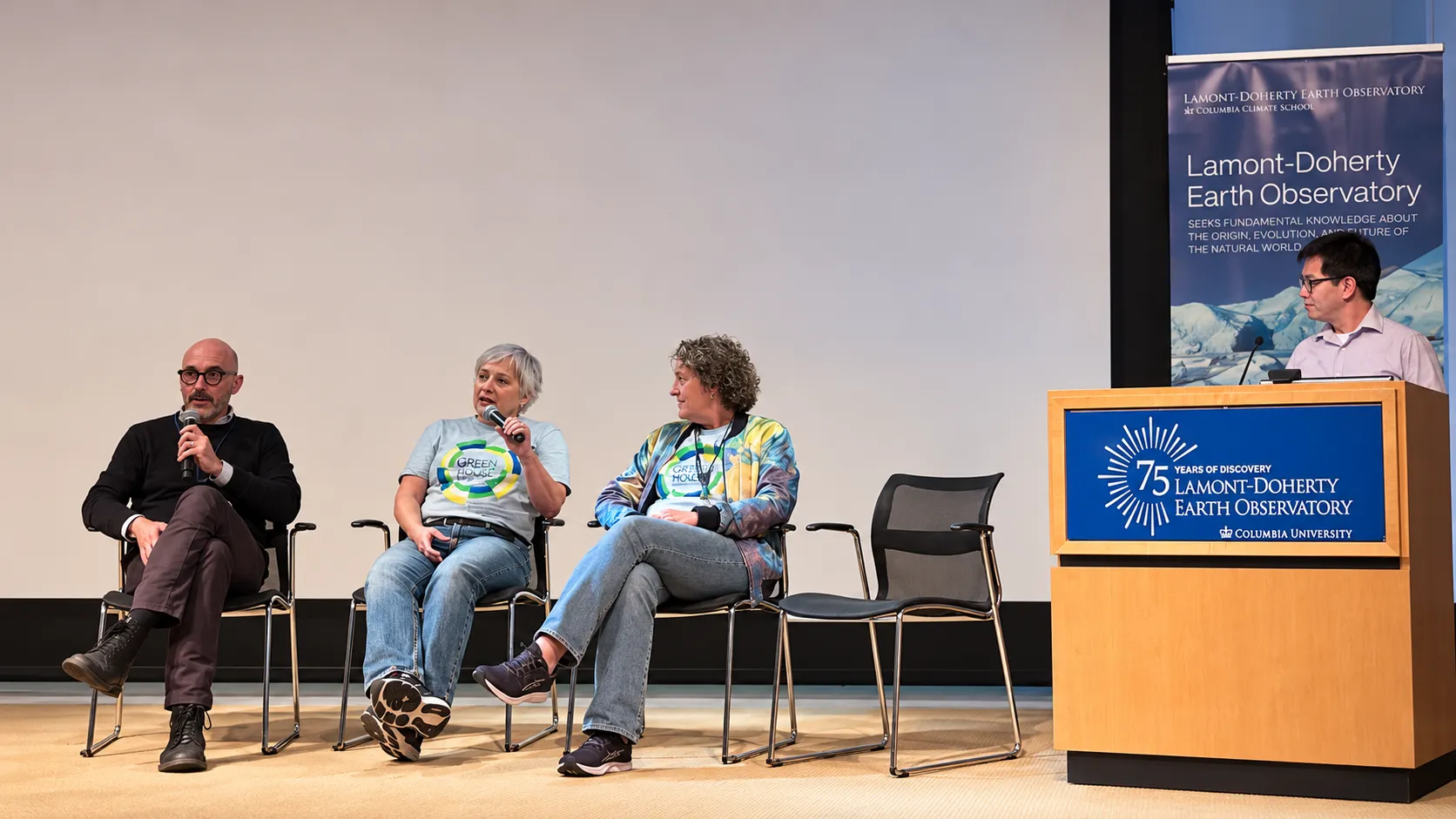
The advance illustrates AI’s expanding role in climate science. At an October 17 Columbia panel, researchers discussed ways to study rising seas, ocean carbon uptake and seafloor data with AI. “People can actually download our code, and they can run their own simulations,” said Marco Tedesco, a Lamont research professor at Columbia Climate School’s Lamont-Doherty Earth Observatory.
His team trained an AI system to imitate a conventional ice-sheet model, which uses climate data and physical equations to estimate Greenland’s contribution to rising seas. It runs on local computers, Tedesco said, without relying on the large data centers used by some AI systems. Faster simulations could help researchers explore more possibilities for Greenland’s future ice loss, information that may help coastal communities plan for rising seas.
The panel was part of Lamont’s annual open house at its campus in Palisades, New York. Daniel Hsu, an associate professor of computer science and associate director for research at Columbia’s Data Science Institute, moderated the discussion. He highlighted work that brings computer scientists and climate researchers together, including the National Science Foundation-funded Learning the Earth with Artificial Intelligence and Physics center, known as LEAP. The center combines machine learning with physical models to improve near-term climate projections.
“Research ships can sample only a small fraction of the ocean,” said Galen McKinley, a professor of earth and environmental sciences at Columbia and a senior scientist at the Lamont-Doherty Earth Observatory. Oceans absorb much of humanity’s carbon dioxide emissions, making changes in that uptake important to understanding warming.
The gaps were clear in a map of observations from June 2016. “We only get about 2% coverage, but when we use AI, we can fill in those gaps,” she said.
Her team combines those readings with satellite measurements of sea-surface temperature and chlorophyll, a marker of microscopic marine life. AI then produces monthly maps estimating where the ocean absorbs carbon dioxide and where it releases it, even in rarely sampled waters. Comparing the maps over time helps scientists see whether this natural brake on warming is changing.
Other scientists struggle to find existing data. Vicki Ferrini, the Marie Tharp Senior Research Scientist at Columbia Climate School’s Lamont-Doherty Earth Observatory, helps preserve roughly 120 terabytes of research-vessel records. Many came from voyages made decades ago and could never be collected again. Related seafloor measurements contribute to the detailed underwater maps in Google Earth, while other records remain hard to find in separate repositories.
Ferrini described a recent example: After her team put new expedition material online, she found that Google’s Gemini had connected it to records from the same voyage held in other repositories. Such connections could put hard-won historical measurements to new scientific uses.
But AI has limits. Its methods “can be unreliable in kind of surprising ways,” Hsu warned. McKinley made a related point: AI weather forecasts draw on decades of observations and data from physics-based models, but scientists still need to recognize predictions that make no physical sense.
Poor training data can also cause models to miss extreme events, Tedesco warned, precisely the changes climate researchers most need to understand.
The examples point to a division of labor, with AI running the calculations and flagging what people might miss while scientists decide what to trust and why. Ferrini sees that split as the whole point. Machines can take on the grinding work of sorting data, leaving people to wrestle with the questions no model can settle alone. “It frees up our time and our intellect to focus on the real problem-solving,” she said.