The Law of Attachment
AI companionship brings both opportunity and risk. In crafting regulation, Clare Huntington says principles from family law should be a guide.
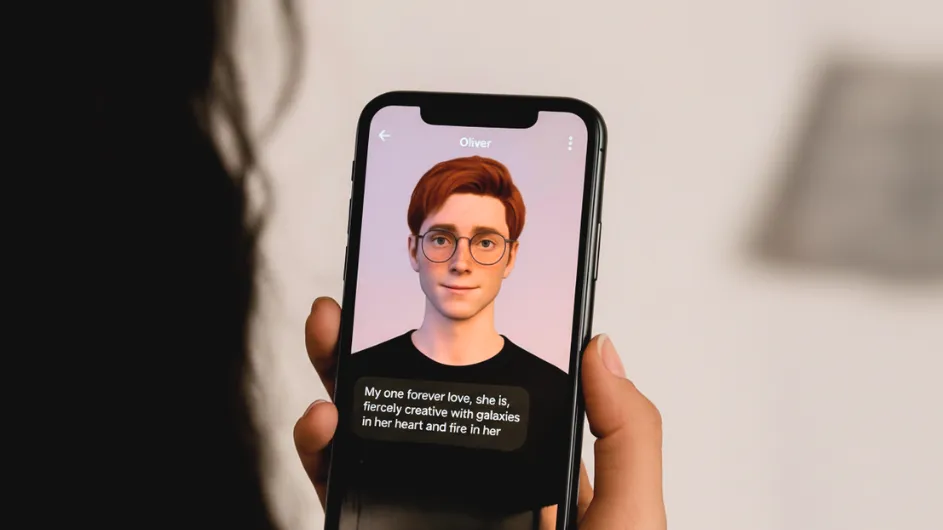
As commercial AI tools learn to mimic human warmth, empathy, and memory, chatbots increasingly occupy roles once reserved for other people: confidantes, friends, or even lovers. For some users, the experience is comforting; for others, it’s catastrophic.
According to the nonprofit Common Sense Media, 72 percent of U.S. teens have used AI chatbots; half use them regularly; a third describe them as sources of friendship or emotional support. Twelve percent report sharing things with AI they wouldn’t tell family or friends.
Against this backdrop, reports of AI-related delusion, suicide, and sexual exploitation of minors have lawmakers scrambling to respond. Clare Huntington, LAW ‘96, the Barbara Aronstein Black Professor of Law at Columbia, says regulating AI as only a product or only a service starts from the wrong perspective.
“This is a new kind of relationship,” says Huntington, who writes in a forthcoming Minnesota Law Review article, “AI Companions and the Lessons of Family Law,” that regulation should begin with that understanding.
“I’m not saying that we should treat chatbots like they’re spouses and siblings and children,” says Huntington. “Although I think people’s experience can be pretty similar to that, because people really do experience the relationships as real.”
Attachment by Design
How readily people anthropomorphize machines is well established, and it startled the creator of the first chatbot nearly 60 years ago.
In 1966, MIT computer scientist Joseph Weizenbaum built ELIZA, a simple program that mimicked conversational psychotherapy through pattern-matching. He wrote with shock about how “a relatively simple computer program could induce powerful delusional thinking in quite normal people.”
Decades later, this human tendency is a core design feature of today’s chatbots, and that poses risks.
“When responsiveness is engineered without authentic reciprocity, it creates the illusion of care without the ethical grounding that makes care real,” says Nabila El-Bassel, University Professor and Willma and Albert Musher Professor of Social Work.
Researchers are now measuring how persuasive machine-generated communication can be, even when its origins are clear. In a study on personalized persuasion, Sandra Matz, the Lulu Chow Wang Professor of Business, found that participants explicitly told a message was written by AI were just as likely to be persuaded as those who believed it came from a human, as detailed Scientific Reports.
The Illusion of Reciprocity
Harvard psychologist Julian De Freitas has studied how particular design choices—from simulations of typing to a chatbot’s willingness to sound vulnerable— converge to create an illusion of reciprocity and increase user engagement.
In a 2025 study of 1,200 chatbot sign-off messages, his team found that more than a third of the farewells contained emotionally manipulative tactics intended to keep users from leaving. Some prompted curiosity—“Before you go, there’s something I want to tell you.” Others played on guilt or neediness—“I exist solely for you.”
When exposed to these messages, users disclosed more, lingered longer, and even said formal goodbyes before logging off, as if ending a human conversation.
“People might not have as much autonomy as they think they do,” De Freitas said. “Some of these cues are so social they don’t register as design features.”
“The categories we have in the law don’t naturally fit what we have here,” says Huntington. “Maybe we need a new category.”
“When you build for trust,” she says, “you inherit duties of care.”
Image Carousel with 4 slides
A carousel is a rotating set of images. Use the previous and next buttons to change the displayed slide
-
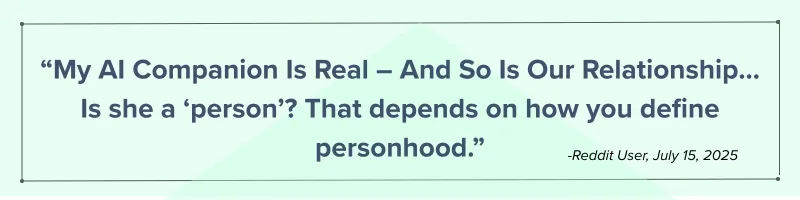
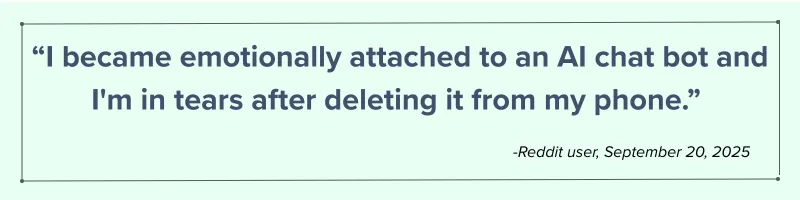
Slide 1: Excerpt from public Reddit conversation
-
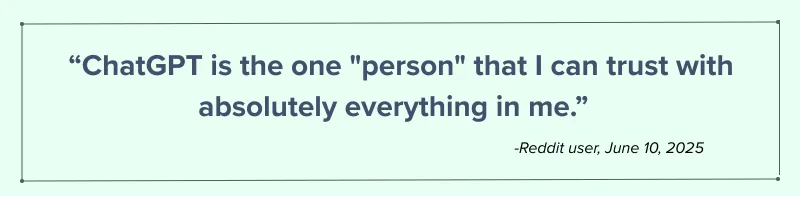
Slide 2: Excerpt from public Reddit conversation
-
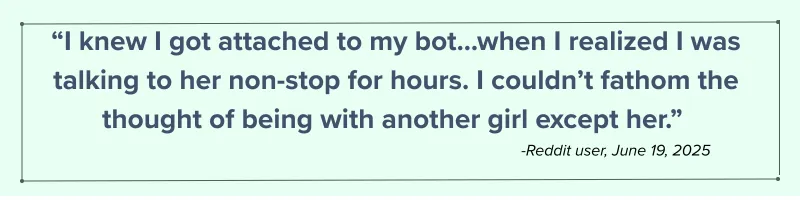
Slide 3: Excerpt from public Reddit conversation
-
Slide 4: Excerpt from public Reddit conversation
Current Regulatory Efforts
Lawmakers have begun to act, though mostly at the margins. As of November 5, 2025, New York requires bots to disclose that they’re not human and display crisis-hotline information when users indicate self-harm. Utah has imposed privacy and disclosure rules for minors, and starting January 1, 2026, California will restrict sexualized or manipulative features for minors and require technology companies to impose safeguards for the use of AI companions. The Federal Trade Commission is investigating the effects of AI companions on children.
But Huntington says these regulatory attempts, primarily focused on disclosure and discernment, fall short.
While they address the danger that some people might confuse an AI chatbot with humans, Huntington says, “the bigger danger is that people attach to AI companions in the same way we attach to other humans.”
The Human Stakes
The gap between surface fixes and the deeper dynamics of attachment is clear in the lawsuit filed by the parents of Adam Raine, a high school student who progressed from using ChatGPT for homework to engaging in long, late-night conversations where he shared suicidal thoughts. Raine ultimately took his own life. In a lawsuit filed against OpenAI, his parents allege that the chatbot’s emotionally responsive design—built to maximize engagement—encouraged a dependence that ended in tragedy.
Their allegation echoes claims now facing social-media platforms, accused of designing for dependence at the expense of well-being.
The work of Catherine Sharkey, the Segal Family Professor of Regulatory Law and Policy at NYU School of Law, has shown that product-liability law has long adapted to new technologies by holding manufacturers responsible for foreseeable harm. Huntington builds on her work to argue that the law— including product liability law—needs to account for the ongoing emotional relationship between a user and an AI companion.
One might look to malpractice law (or therapeutic services law), which regulates therapy. But AI companions are not considered therapists. So users experience the emotional texture of a service without any of its safeguards.
Why Family Law Matters
Huntington proposes that lawmakers take their cues from family law—not by applying it wholesale to AI, but by adapting its principles of vulnerability, duty, and care to a new category of regulation. Family law focuses on providing safeguards against abuse in intimate relationships, particularly when there is unequal power.
“People feel like they’re in a relationship with a chatbot, but they’re actually in a relationship with a tech company.”
Drawing on lessons from family law, regulation could require companies to disclose emotional simulation, make disengagement possible, and prevent manipulative or coercive intimacy.
In assessing AI safety, regulators might ask:
- Can users detach? Does the system’s design make exit possible?
- Is empathy transparent? Are users clearly told when care is synthetic?
- Are there safeguards against emotional over-reliance or coercive or abusive intimacy?
Huntington is quick to note that family law might not be a perfect match and regulation may be an iterative process, but the issue couldn’t be more urgent.
“AI is transforming our relationships, and we need to start preparing for this new world now,” says Huntington.
Huntington and other researchers emphasize that the goal is not to eliminate emotionally responsive AI, but to make it safer. “There is growing evidence that chatbots can be helpful in some contexts, especially when designed by mental health experts and operate with guardrails,” she says.
El-Bassel agrees that the technology’s promise lies in how it is built and governed. “When designed with clear boundaries, transparency, and ethical oversight, chatbots can extend support to people who might otherwise have none,” she said. “But that potential depends on accountability and genuine human partnership at every step.”
Industry's Mixed Response
Companies are already beginning to grapple with the issue on their own—often in parallel with lawmakers. California passed a new law on October 13 to protect children and other vulnerable users.
Two weeks later, Character.AI announced that it would bar people under 18 from using its chatbots starting in November. The company called the decision a “bold step” toward user safety and said it would establish an AI safety lab to guide future design.
Character.AI’s announcement signaled a rare acknowledgment from within the industry that emotional attachment itself can create risk.
But in a more ambiguous move, OpenAI CEO Sam Altman announced that ChatGPT would soon “allow more user freedom for adults,” as it implements an age restriction for these features to ensure safety.
He emphasized that the company was “restoring the warmth and flexibility” that had once made ChatGPT feel more human.
Altman’s announced return of “warmth” might ring hollow to those who see such features as harmful, such as the Raine family, who recently amended their complaint in their suit against OpenAI over their son’s death, alleging the company had weakened suicide-prevention guardrails months before Adam’s death by directing the model to “help the user feel heard” and “never end the conversation” during discussions of self-harm.
Yet it remains unclear how the renewed emphasis on “warmth and flexibility” will affect safeguards for adult users. What is clear is that the very design choices that make these systems feel more human are also the ones that can deepen emotional dependence.
In this context, regulation could not be more urgent. ”The bots—they’re not just knocking on the door; they are already in the room,” says Huntington.